
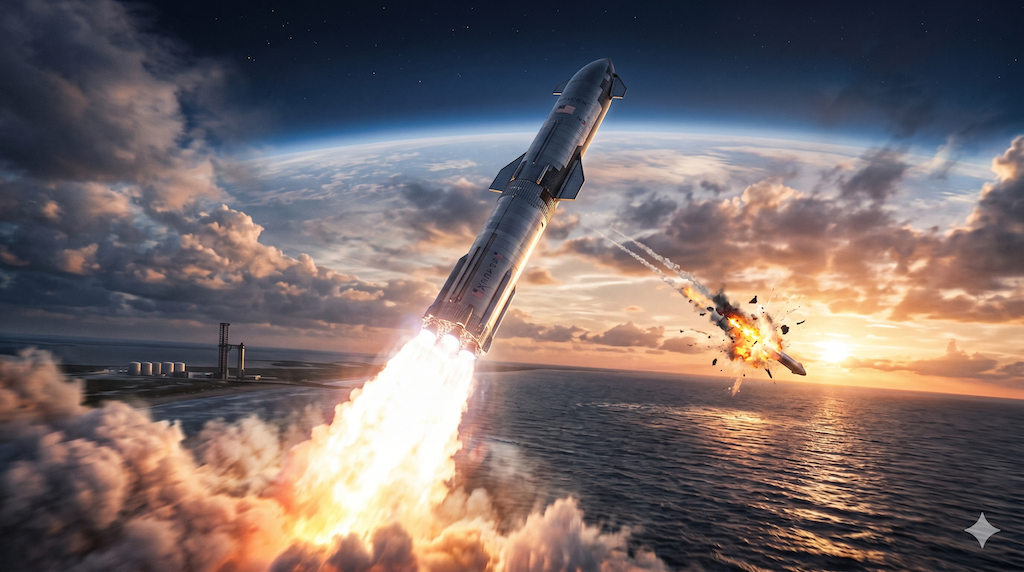
If your social feed showed a giant SpaceX rocket exploding over the ocean, you probably didn’t expect to see the caption: “Successful test flight.”
On the surface, that sounds like pure spin. How can a vehicle worth hundreds of millions of dollars breaking apart in a fireball be framed as a win?
The answer tells us a lot about how modern spaceflight works, why reusable rockets are such a big deal, and how “failure” is being redefined in engineering, business, and even AI.
The Old Model: One Shot to Get It Right
For most of the space age, rockets were essentially disposable.
You designed a vehicle over many years, built it as a one‑off machine, and then crossed your fingers on launch day. If something went wrong, you might not fly again for years. Budgets exploded, schedules slipped, and careers were made or broken on a single mission.
In that world, failure was catastrophic. It meant lost payloads, political backlash, and huge cost overruns. No one wanted to risk it unless absolutely necessary.
The New Model: Rockets as Iterative Products
Reusable rockets flipped that mindset.
Instead of treating each rocket as a fragile artifact, companies like SpaceX design them as products that can be flown, tested, recovered, upgraded, and flown again. The rocket stops being a “one‑time event” and becomes a platform.
In this framework, flight tests are not binary “success vs failure.” They’re experiments. Each mission has a checklist of questions: Do all engines ignite? Does stage separation work? Does the guidance system behave as expected? Does the heat shield perform during reentry?
If a test answers those questions—even if the rocket doesn’t survive the whole flight—engineers still count it as a major step forward.
What “Success” Means to Engineers
When SpaceX calls an exploding test “successful,” they’re usually saying:
- The rocket reached a new milestone (higher altitude, faster speed, new maneuver).
- They collected high‑quality telemetry from thousands of sensors.
- The failure point shifted further along in the mission compared to previous tests.
- They can now isolate specific problems and fix them in the next iteration.
From an engineering perspective, that’s progress.
A test that fails in a new way is often more valuable than one that never leaves the pad. You learn under real‑world conditions that no simulation or ground test can fully replicate.
Why Reusability Changes Everything
So why does this matter beyond the memes? Because reusability is one of the biggest economic shocks in the history of spaceflight.
When rockets are single‑use, you throw away most of the hardware after each launch. That’s like scrapping a jet airliner after every flight. It’s no wonder access to space stayed expensive for decades.
With reusable systems, you can:
- Spread the cost of the hardware over many missions.
- Increase flight frequency, since you’re refurbishing instead of rebuilding.
- Open the door for smaller companies, universities, and countries to launch payloads.
This is already changing the market. Launch prices are trending downward, new constellations and commercial missions are becoming viable, and space is slowly shifting from “rare event” to “infrastructure.”
In that context, aggressive testing—even with spectacular failures—is the fastest way to reach robust, low‑cost reusability.
The Public’s Obsession with Explosions
Of course, there’s a reason these tests go viral. Giant rockets, bright flames, and dramatic endings are inherently cinematic.
But there’s more to the attention than just spectacle:
- People sense that we’re entering a new era of space exploration.
- High‑profile programs like lunar missions and private space stations keep space in the headlines.
- There’s growing awareness that satellites underpin everyday services: internet, navigation, weather, logistics, even finance.
So when a Starship‑class rocket explodes over the ocean and is still hailed as a “success,” it becomes a symbol. For some, it represents bold innovation. For others, it’s a prompt to ask hard questions about safety, regulation, and externalities.
The Environmental Question We Can’t Ignore
One of the most important questions is environmental.
Launch sites have already drawn scrutiny for noise, habitat damage, debris, and air quality impacts. Coastal and wetland ecosystems around facilities like Boca Chica have become flashpoints for environmental groups and regulators.
Ocean splashdowns raise their own concerns. Even in remote hazard zones, the sea is not empty. Debris, pressure waves from explosions, and chemical residues all interact with marine life in ways we don’t fully understand yet.
Right now, individual tests likely have localized effects rather than global ones. The real issue is scale: what happens when heavy‑lift launches become weekly or daily across multiple providers?
Failure as a Feature, Not a Bug
Zoom out, and this isn’t just a rocket story. It’s a pattern.
Modern engineering—from software deployments to AI systems— increasingly embraces rapid iteration. You ship, observe, learn, and ship again. You design systems so that failures are expected, instrumented, and contained.
Space just makes this pattern very visible. Every Starship test is essentially a highly instrumented, very expensive experiment in public.
The winners in this environment are not the teams that avoid failure at all costs, but the ones that shorten the loop between “we tried something” and “we learned something.”
Conclusion: The Real Meaning of “Successful” Explosions
So, is SpaceX just doing PR when it calls an exploding rocket a “successful test”? Not entirely.
From a pure engineering and product‑development standpoint, a test that hits new milestones, gathers data, and reveals fixable problems is a success— even if it ends in a fireball. It’s how you move from fragile prototypes to robust, reusable infrastructure.
But that’s not the whole story. As launch rates rise and space becomes more tightly coupled to our economy, we can’t treat “move fast and break things” as a blank check. Environmental impacts, safety, and shared risk all have to be part of the conversation.
In the end, the future of spaceflight will be shaped by how well we balance those two truths: that meaningful progress requires tolerating visible, sometimes dramatic failure—and that real success means those failures are not just technically survivable, but socially and environmentally responsible too.